Summary
Connection Central is where Quickbase admins work out which systems, connections, tables and pipelines are touching company data. Johnny Lee's first version already exposed a lot of information, but answering "what does this touch?" still took too much reconstruction.
In 2024 I led v2: research, information architecture, interaction design, the MVP cut and the post-launch measurement plan. A study with 13 Solution Architects pointed the page at resources first. Then, on 22 July, I started deleting my own design, because I had drawn more than engineering could responsibly build before GA. We skipped the beta, and Connection Central v2 reached GA on 17 December 2024.
Designed by Alex Traykov, with co-research by Lisa Sawyer. PM Stasha Markovska; engineering lead Dimitar Arnaudov. Built on Johnny Lee's v1.
From the cut to the read-back
Start
Richer detail cutAccordion and popover detail out of the MVP, so engineering could build it before GA.
107 days later
Straight to GAThe PM and I decide to skip the beta to meet the H2 date.
41 days later
v2 liveConnection Central v2 reaches GA.
- The read-back
3,110 accounts use the page.
Give v1's information a map
Johnny's v1 was not a failed product. It had accumulated enough views that builders could see individual objects without reliably following their relationships. A connection, the resources it exposed and the pipelines that depended on it could all be on screen, and "what does this touch?" still needed rebuilding by hand.
I could have redrawn the existing tabs and called it cleanup. Instead I treated the information architecture as the product decision: what should a person start from when they are trying to understand a complex, live integration estate?
Lead with the resource
Before proposing a structure, I ran a Structured Association study with 13 Solution Architects. They were close proxies for experienced builders who spent time in Pipelines and customer playback, not external customers. That limit belongs next to the finding.
The pattern was consistent enough to change the top-level split. People described a resource, the connected system and what it exposed, before they described the internal object model around it. They wanted to know what a connection affected, what depended on it and where to inspect the consequences. The research did not validate every detail of the later UI. It gave me a credible reason to lead with resources.

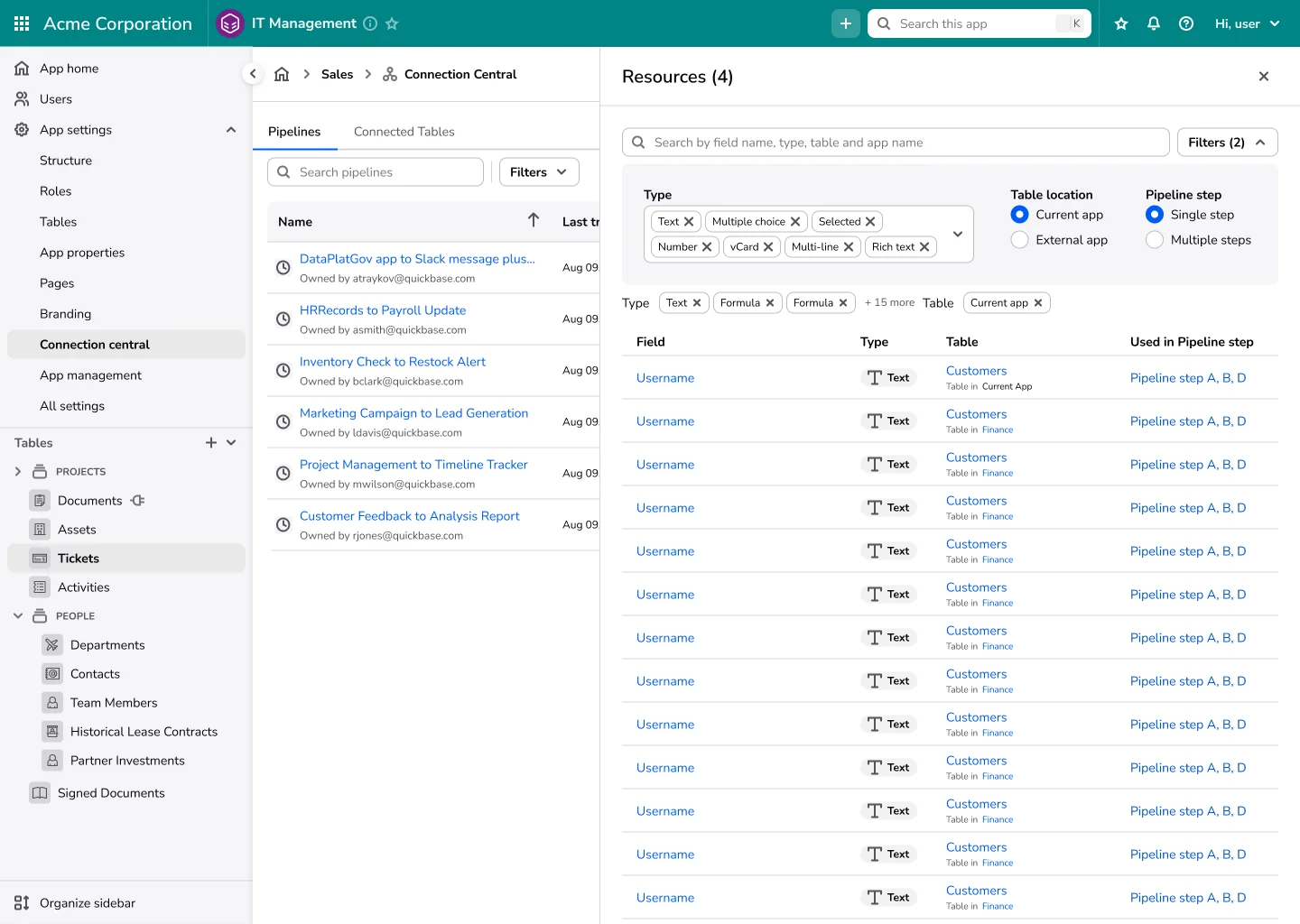
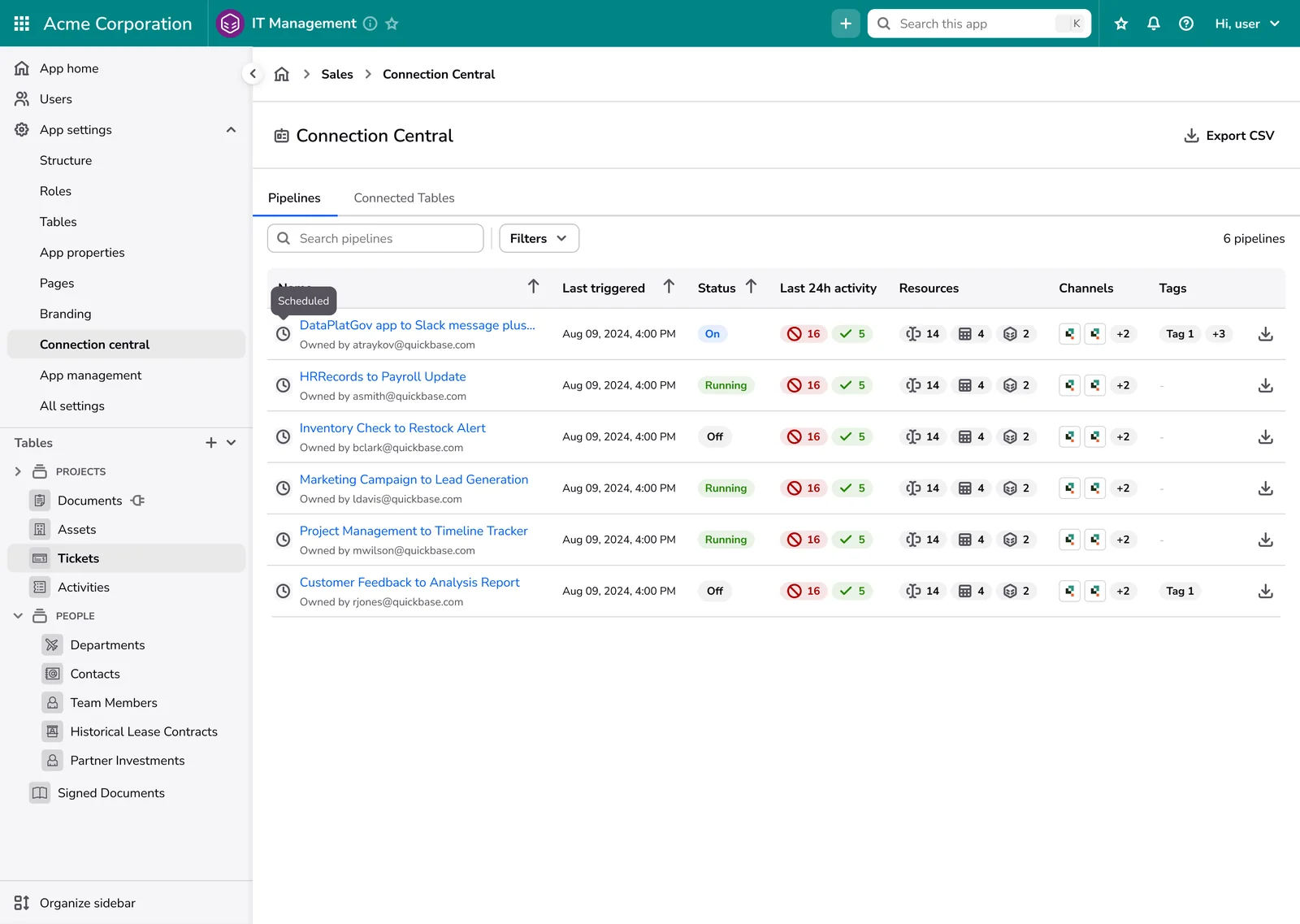
The illustrations in this study come from the v2 design specification, not from screenshots of the GA release. The structure was the decision I protected.
A builder should begin with the resource and keep its relationships visible while they inspect it.
Keep the map while inspecting one thing
The core interaction was two panes. Navigation stayed on one side; detail appeared on the other. A builder could drill into a connection without losing the surrounding resource map. That was the part of the control-room metaphor that held up under real constraints: one view keeps the context while the other does the detailed work.
The companion Pipelines view gave the domain a first-class list for a different question: what is running here? Its Export CSV and 24-hour activity concepts were deferred from the December release.
Cut what the first release did not need
Research gave me a better information architecture and, naturally, enough good ideas to miss the release date. Engineering had a fixed December GA date and limited UI capacity late in the work. The useful question was no longer which version I preferred.
I kept the resources-first IA and the two-pane shape. The accordion and popover detail did not survive. Neither did field-level detail, the 24-hour activity emphasis or CSV export. They were deferred, not quietly recast as shipped work.
The rich inline detail demoed well. It was not load-bearing for the first release. The two-pane model fit the scope and kept the context the research had actually made important.
The cut followed one question: which decision would be expensive to reverse after launch?
Launch without a beta
On 6 November, the PM and I decided to go straight to GA to meet the H2 date. There was no beta. This is the sort of sentence that looks decisive in a portfolio and feels considerably less elegant while making the call.
I wrote the v2 Pendo strategy so the team could read the surface after launch: a new-feature guide, an onboarding walkthrough, a feedback poll and a help update. Measurement was a follow-up, not a substitute for testing.
Read back the first numbers
From 20 July 2025 through 19 July 2026, the reporting record shows 3,110 accounts using the Connection Central page. Separately, the measured entry-point population included 2,297 paying accounts, about 51.9% of the measured paying-account base. These are different populations. They describe reach, not revenue, a redesign lift or the quality of anyone's decision.
I leave raw event volume out because automation contaminated that stream. I also leave the longer-window navigation funnel out, because it does not establish a same-session usability result.
The question that mattered when the project began is still open: did the resources-first model stop people from making a mistake, or help them recover when they were unsure? This data cannot answer it.
In short
Connection Central v2 is the project where I deleted a good part of my own design to keep the one decision that would be expensive to reverse: start from the resource, and keep its map in view while you inspect one thing. Thirteen Solution Architects picked the model, the cut made the December date, and 3,110 accounts used the page in the year the read-back covers. None of that shows where someone hesitates, misreads a status or loses confidence in the middle of a real investigation. I would still protect the launch date, but I would fight harder for a small moderated pass with the same Solution Architects before GA.
Related work
Designing trust into Quickbase Pipelines covers the automation surface whose relationships Connection Central needed to make inspectable.
Designing Pave shows a related AI-builder navigation and recovery problem at public-launch scale.